Cascadia Research has been conducting long-term studies of the Sounders, a group of gray whales in North Puget Sound (NPS), as a part of a larger study of gray whales in the Pacific Northwest. While the first of the Sounders appeared to discover this area in 1990-1991, additional whales arrived in 1999-2000 and again starting in 2018- 2019. These periods coincided with Unusual Mortality Events, and appear to be when whales were potentially searching for food after their winter fast and long migration.
During their northern migration from Baja California, these individuals break off the migration route to feed on ghost shrimp each spring (approximately March-May) in the North Puget Sound waters before continuing north to the Bering and Chukchi Seas. However, more recently some individuals have arrived in Puget Sound as early as December.
Photo-ID
Cascadia has gathered data on the Sounders for more than 30 years documenting the individuals that return and the timing of their stays here.
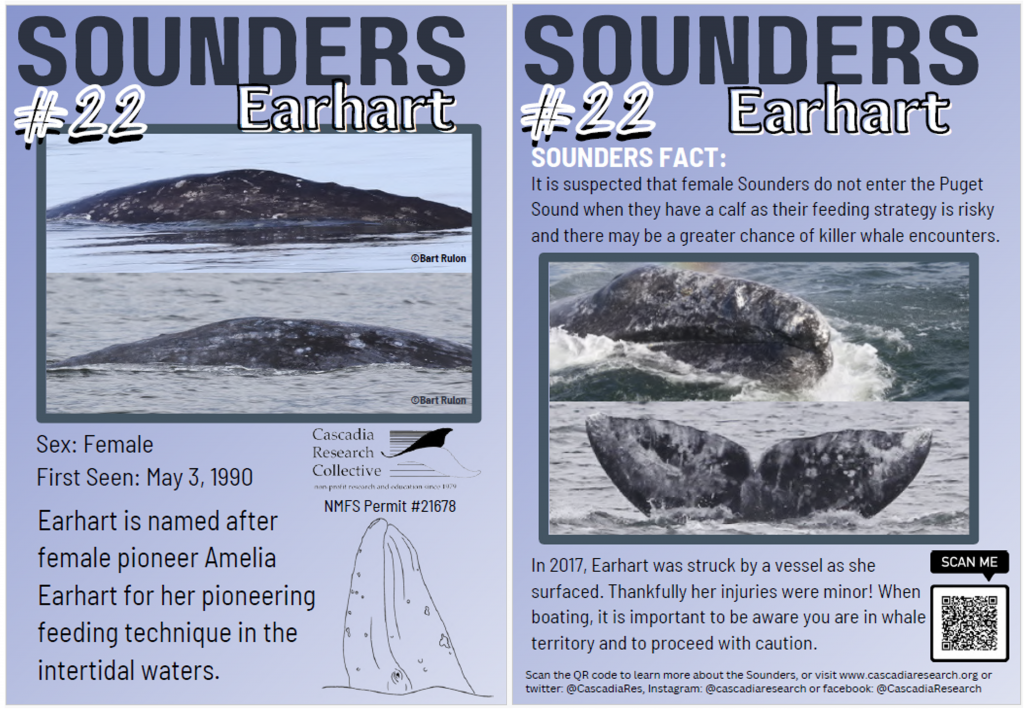
Click on the image to learn more about the Sounders trading cards.
Click the button to purchase the 2024 Identification Guide to Northern Puget Sound gray whales (Orca Network).
Click here to learn more about specific Sounders and their names.
An example of the Sounders trading cards. Click image to learn more and download them.
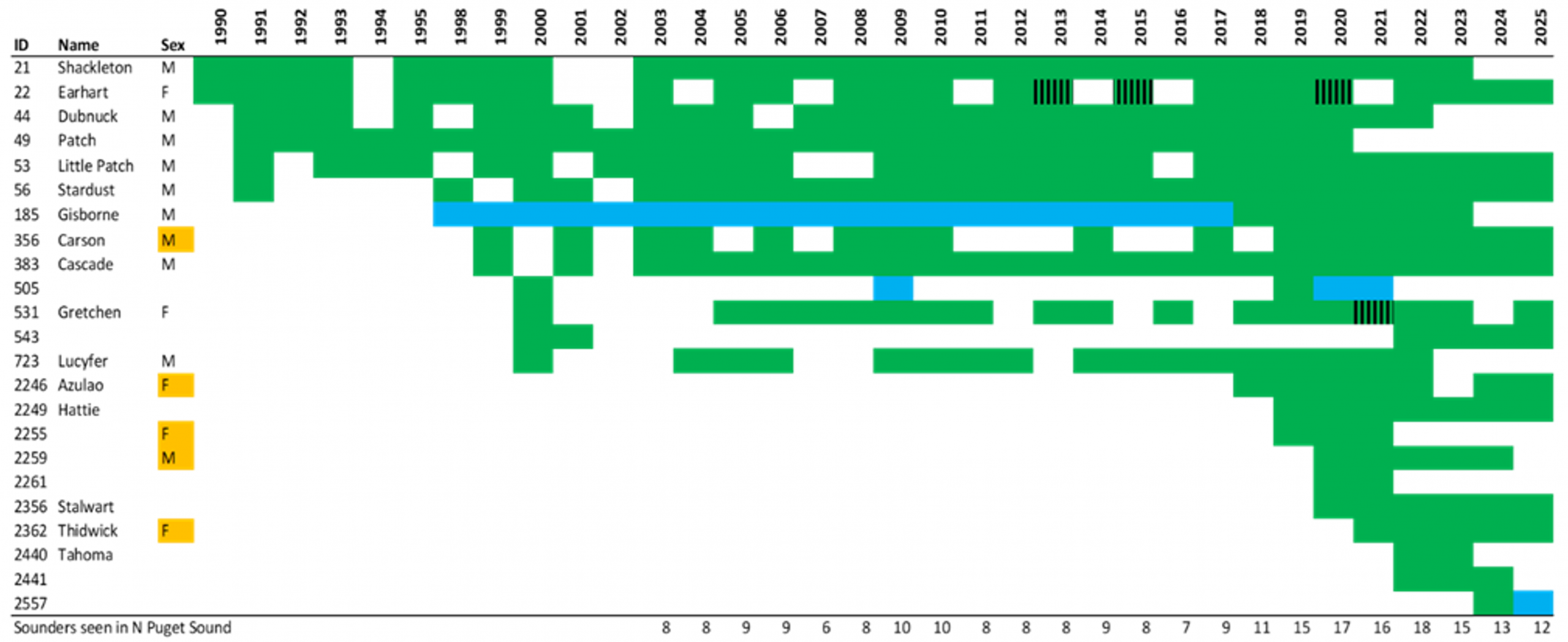
The sex of 15 of the Sounders has been determined genetically from skin samples, ten are male and five are female. None of the known females have been seen with a calf, though there have been periodic gaps in their visiting the area which may indicate they are calving some years but not bringing the calf here. This could be due to later timing in migration after having a calf, or to avoid risk to the calf in the more dangerous inland waters.
Summary of annual sighting histories of Sounder gray whales by individual and year also showing name and sex. Filled in boxes indicate whale was seen that year, green if in the Sounder area, pink if see in a different area and stripped if suspected or known to be pregnant that year based either on sighting on wintering ground or UAS evaluation of pregnancy from John Durban and Holly Fearnbach (SR3).
Feeding, prey, and health studies
In 2015-16, with support from DNR, Cascadia conducted expanded dedicated surveys, photo-ID, tag deployments to examine feeding behavior, and documenting feeding locations. The project addresses a number of objectives related to key elements required to address gray whale consumption and reliance on ghost shrimp in the northern Puget Sound region. Since 2023, we have further expanded our research and collaborations with partners to study the Sounders.
Major elements of our current research include:
Deploying multi-sensor suction-cup video tags
Examining prey, feeding behavior, and energetics of the Sounders.
Using aerial images to count feeding pits in current and past years.
Analyzing the apparent higher number of Sounders, and their increase in duration of time spent in NPS, during Unusual Mortality Events
Examining the health condition of the Sounders through a joint project with John Durban and Holly Fearnbach, initially supported by NOAA.
Tag Deployments & Energetics
The deployment of multi-sensor suction-cup video tags in 2015, 2016, 2021, and 2023 including the first drone-deployed tags on gray whales in April 2023 (with Ocean Alliance).
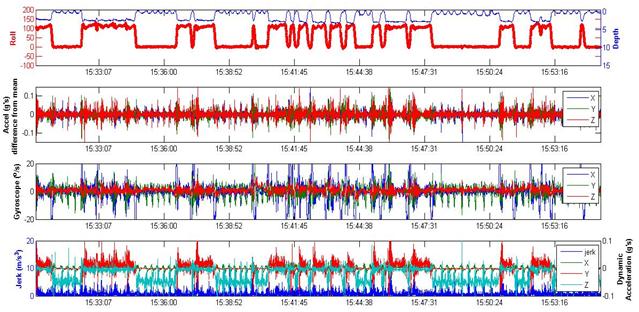
These revealed that feeding events can be discerned from characteristic feeding posture and behavior from the dive kinematics of the tags and that the whales were almost exclusively feeding in shallow intertidal waters during short periods at high tide.
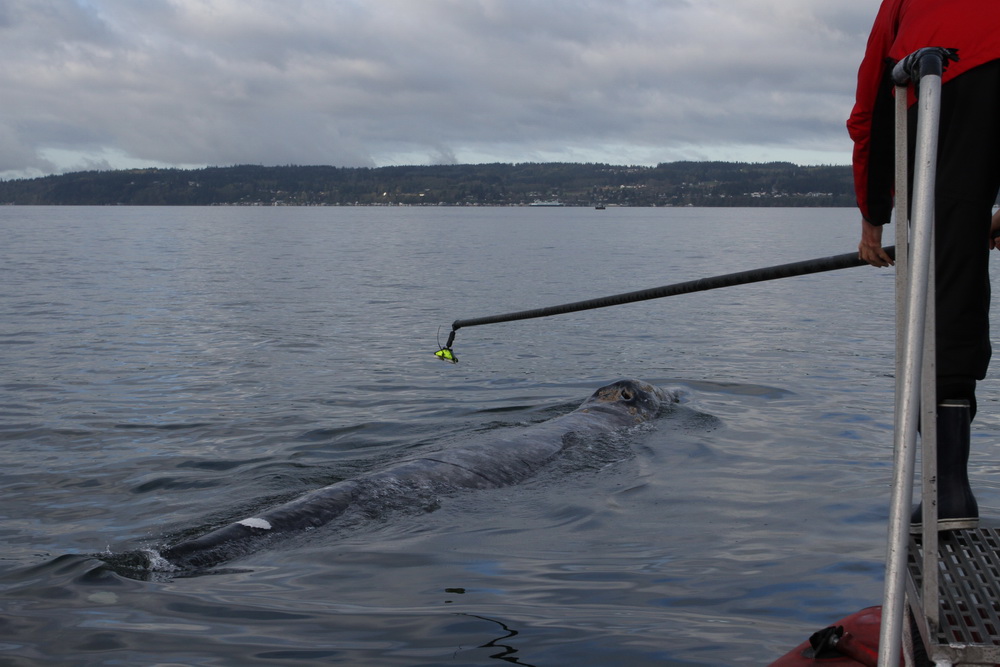
See Cascadia Youtube Channel for videos of deployments and some clips from the more than 9 hours of dual footage from the deployments on CRC ID 723
Deployment of suction-cup attached video tag on CRC ID 723 on 25 March 2016. Tag stayed on for 23 hours.
Sample of data off tag on ID 22 while it was feeding on ghost shrimp on the Snohomish Delta on 17 April 2015. Top section shows dive depth in blue and roll in red, demonstrating the whale feeding with rolls to 90-100 degrees for extended periods on bottom section of each dive down to just 2-3 m water depth.
Expanding on past work done by Laurie Weitkamp and Washington DNR, Stanford PhD student Hannah Clayton, has be examining the prey, feeding behavior, and energetics of the Sounders.
Hannah also examined the acoustic behavior of the Sounders during tag deployments. Clayton et al. (2023) detected 141 calls from gray whales in ~ 128 hours of data collected during tag deployments. The most prominent call types included pulsive ‘rumble-like’ calls, upsweeping tones, and moans.
You can read about the results of that recent study here.
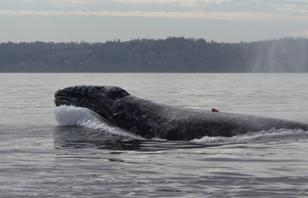
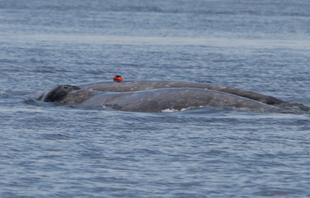
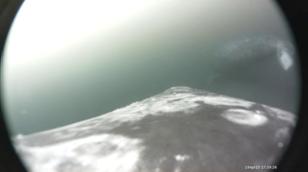
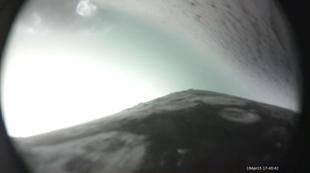
Images of tag deployment on ID 22 on 17 April 2015 (top two photos) and samples of video from ID 383 on 19 April 2015 dives off Hat Island (bottom two photos). Bottom photos show ID 49 head down on bottom but not apparently feeding and in bottom right tagged whale rolled on left side but no evidence of feeding.
Feeding Pits
Aerial overflights and satellite images from Google Earth taken at low tide revealed visible feeding pits of the Sounders gray whales in North Puget Sound and feeding locations both in current and past years.
The locations of some of the almost 14,000 feeding pits were documented on the Snohomish Delta in spring and early summer in Google Earth images from 2005 to 2015.
Click here for a poster discussing the use of these Google Earth images as a way to examine feeding areas for gray whales in Puget Sound, Washington.
Click here to read Amanda Rueda’s recent results for her Master’s Thesis analyzing feeding pits documented in aerial images taken from a fixed-wing plane between 2017-2024.
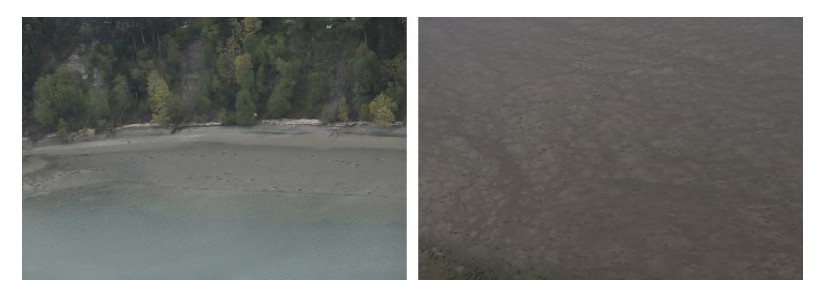
Intertidal feeding pits in northern Puget Sound photographed during aerial surveys. (Left) North of Tulalip Bay. (Right) North of Jetty Island. Photographs by Julia Erickson (Rueda, 2025).
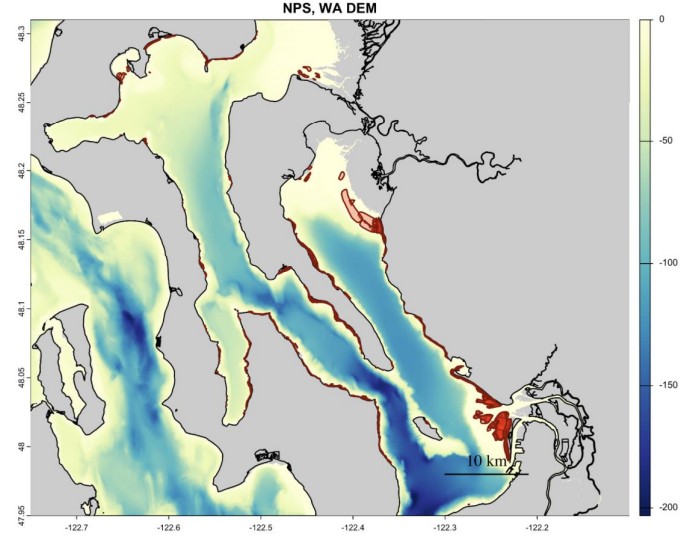
Gray whale intertidal feeding area in northern Puget Sound (2017-2024) plotted in red on a digital elevation model by Hannah Clayton (National Centers for Environmental Information, 2025). Light yellow-dark blue color scale indicates elevation/depth from 0-200 m (Rueda, 2025).
Health Condition
How Robust is Eschrichtius robustus? A Novel Photographic Index of Body Condition From Boat-Based Photographs of Gray Whales, by Telford et al. (2025), is a recent scientific publication resulting from a joint project with John Durban and Holly Fearnbach (SR3) examining the health condition of the Sounders through out the period the feed in the NPS, and how it varies year to year.
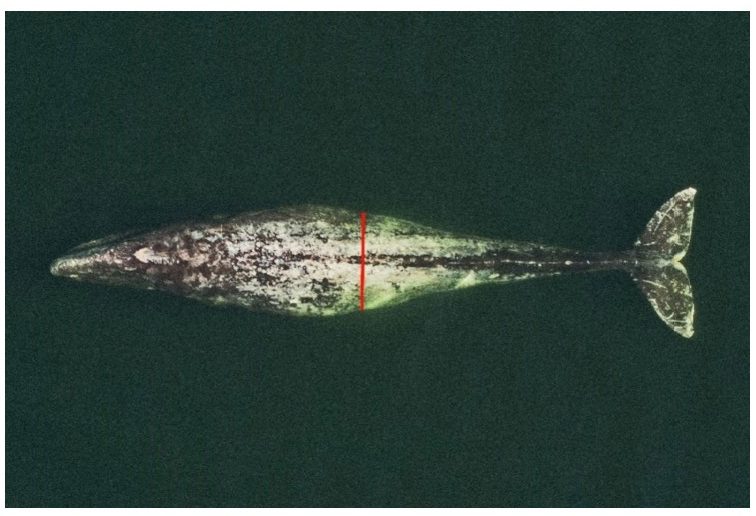
Aerial image of a Sounder gray whale showing the photogrammetric breadth measurement at 50% (red line) which has been shown to be a variable measurement site for gray whales (Stewart et al. 2023). Image was collected non-invasively using an octocopter drone flown at >150 ft. over the whales under NMFS research permit 22,306. Photo by John Durban and Holly Fearnbach (SR3), Telford et al. (2025).