PLEASE NOTE THAT AT THIS TIME WE ARE NOT CURRENTLY ACCEPTING UNDERGRADUATE INTERNSHIP APPLICATIONS OR INQUIRIES.
GRADUATE POSITION INQUIRIES: See “Graduate Student Positions at CRC” below for details. DO NOT SEND MULTIPLE INQUIRIES TO SEPARATE STAFF MEMBERS WITHOUT CC’ING ALL INTENDED CRC RECIPIENTS.
Current and Past Interns & Volunteers | Current and Past Graduate Students
Cascadia Research is a private non-profit research organization founded in 1979. Cascadia receives grants and contracts, primarily from government agencies, to pursue research primarily on marine mammals. Cascadia also makes educational presentations to a variety of audiences; from technical talks to scientists at international conferences to presentations to elementary school children. Based in downtown Olympia, Washington, Cascadia has conducted field research in the Canadian Arctic, Alaska, Washington, Oregon, California, Hawai‘i, Mexico, Costa Rica, and along the Pacific coast of Central America. Cascadia has taken on interns, graduate students and undergraduate volunteers for over 40 years.
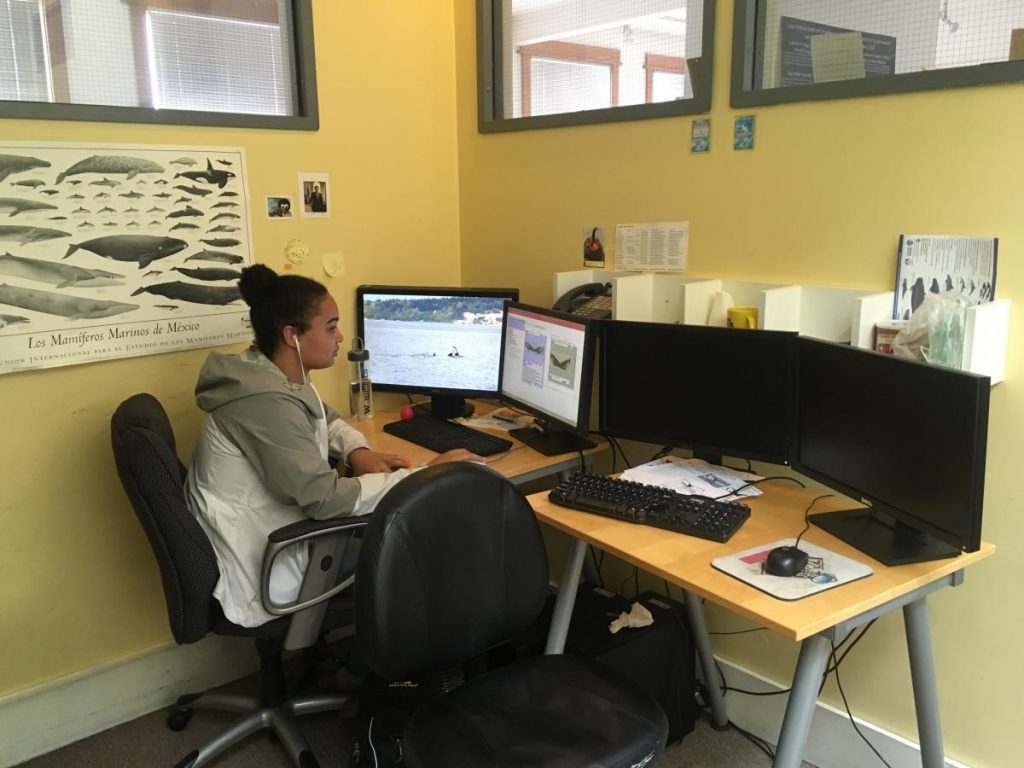
Although we study many marine mammal species, most of our current work is focused either on gray, blue, humpback, and fin whales along the west coast of North America, or a variety of species of odontocetes (e.g., false killer whales, short-finned pilot whales, melon-headed whales, beaked whales) in Hawai‘i. Much of this work involves using photographic identification (photo-id), which entails using the natural markings unique to each individual within a species (such as scarring and pigmentation) to identify individuals. By tracking individuals over time we can study both their individual and population behavior and movements, as well as their population structure. This methodology is labor intensive and is what interns are primarily involved in at Cascadia. Interns typically spend long periods of time comparing photographs to our existing catalogs, but may also include digital image processing, data entry, and tasks related to catalog maintenance.
While photo-ID is a large part of what we do, we utilize a variety of other research techniques, including tissue sampling for genetics and other physiological analyses; cetacean suction-cup tagging with a variety of instruments that can record shorter term movements, dive behavior, sound, or video images; examining dead stranded marine mammals and assisting in live stranding response and disentanglements; satellite tagging a variety of species to track movements over extended periods; and studies of foraging behavior and prey sampling of cetaceans.
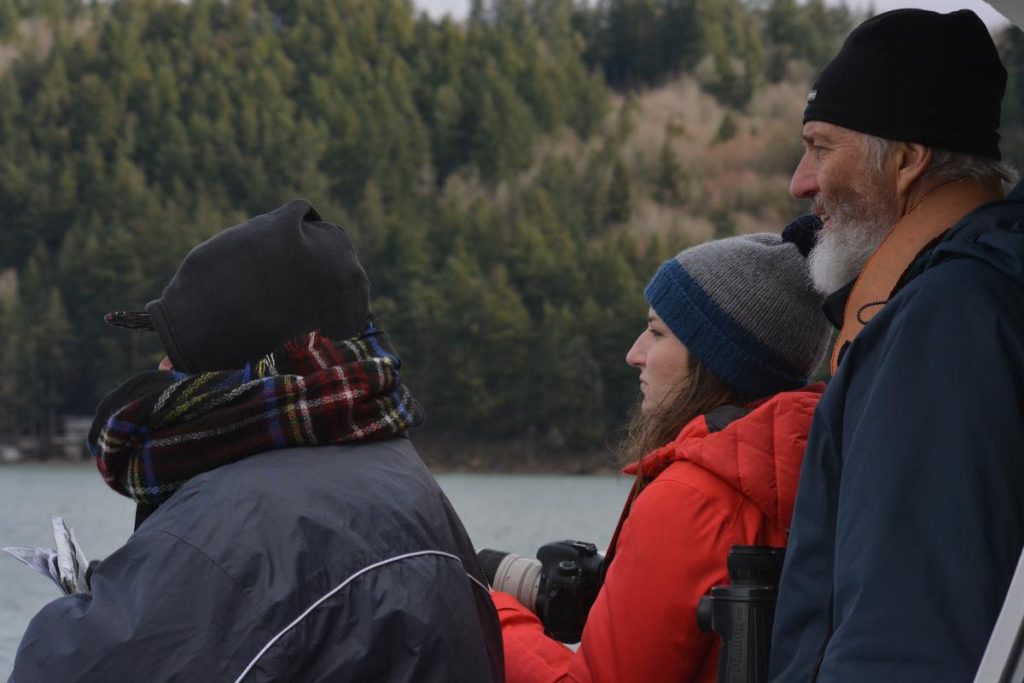
We welcome inquiries from graduate students seeking to collaborate with our U.S. west coast projects and our Hawai‘i research, although both projects are based in our office in Olympia. Below are short descriptions of the two research tracks that we offer to graduate students:
US West Coast Research
Graduate students with our West Coast office typically work with staff members to develop projects related to our long-term photo-ID and tagging databases of baleen whales (e.g., humpback, blue, and gray whales) off the US West Coast and the inside waters of Washington State. While most of our matching is now conducted using automated matching systems, graduate students may be requested to assist in digital image processing, data entry, and tasks related to historical catalog maintenance.

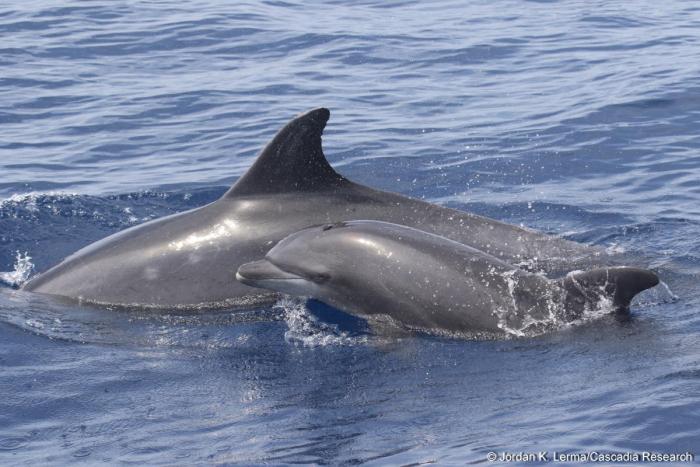
Graduate students with our Hawai‘i office typically work with staff members on projects related to our long-term studies on a variety of species of odontocetes (e.g., bottlenose dolphins, rough-toothed dolphins, false killer whales, beaked whales) in Hawai‘i. Much of this work involves using our long-term photo-identification datasets, or our extensive satellite tag datasets. Graduate students may also have the opportunity to assist in occasional archival work, scientific communication projects, or in-office preparations for field work. For more information on Hawai‘i projects, please visit our Hawai‘i web pages.
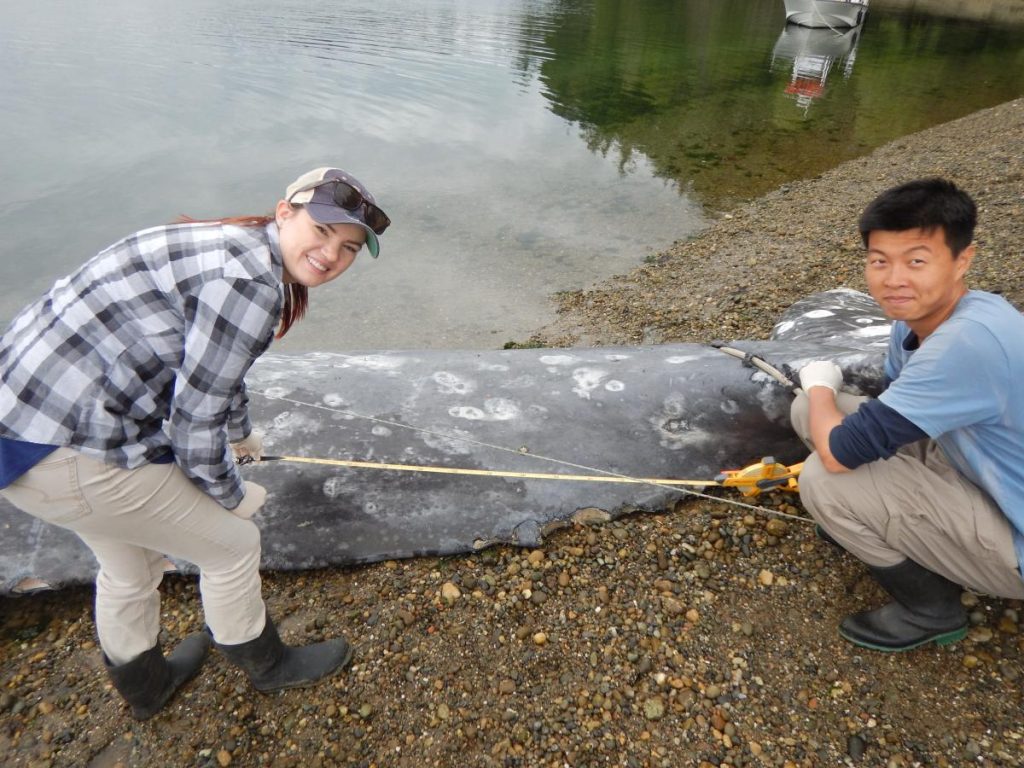
Graduate students involved in both programs will have the opportunity to assist staff in stranding response in Washington State as they come up. This could include participation in beach surveys, data and specimen collection, data entry, and assisting in necropsies of both pinnipeds and cetaceans. Responses may involve hiking into remote areas and carrying heavy loads, and participants should be comfortable with the sight of blood, and strong, unpleasant odors.
Graduate Student Positions at CRC
Cascadia Research takes on students currently in or admitted to Masters and PhD programs that are interested in marine mammal research and/or thinking about marine mammal research as a field of study, and works collaboratively with them to develop graduate projects that match the student’s skillsets and interests. Depending upon the student’s background, experience, skills, and schooling as well as their graduate program’s degree requirements, different paths for the internship may apply. Some students may be asked to do a three-month initial internship with us similar to undergraduates as a way for Cascadia to get to know the individual and for the individual to become familiar with our research and what projects may be of interest to them. After the three month period, a project could be selected if the candidate shows promise, engagement, and dedication. However, other students may come to Cascadia with more relevant and direct experience with marine mammal research, and may be able to start more quickly on a specific research project. For graduate programs where data collection is not a requirement, Cascadia offers a wide range of already available datasets. Fieldwork opportunities for graduate students tend to be limited, and students can expect that the majority of their time will be spent in the office working on data analysis. Cascadia looks for hard working, independent learners with great communication skills, a strong foundation in statistics, and experience with writing results of scientific investigations. Proficiency in MATLAB, R/RStudio, and/or ArcGIS/QGIS is preferred. An objective for working with graduate students is to be able to produce publishable work.
For formal consideration, please send the following to Alexandra Vanderzee (avanderzee@cascadiaresearch.org) and Annette Harnish (aharnish@cascadiaresearch.org), with both recipients included on a single email. DO NOT SEND MULTIPLE INQUIRIES TO SEPARATE STAFF MEMBERS WITHOUT CC’ING ALL INTENDED CRC RECIPIENTS.
1) A letter of interest that includes the following:
a. information on your undergraduate studies (relevant coursework and any research projects)
b. detailed information on the requirements of the graduate program, including:
i. time frame for research, analysis, and writing
ii. type of end product (thesis, project, paper)
iii. committee involvement, readers, or professor sponsorship
c. information about what relevant skills, data collection and analysis experience you have
d. what research at Cascadia interests you and why
2) Two letters of recommendation sent directly to us, at least one of which should be from a previous professor (from a science class)
3) Example of your scientific writing skills (paper, poster)
4) Current CV or resume
Required Qualifications for Graduate Students
- Undergraduate degree from accredited institution, and current or planned enrollment in an accredited graduate program
- Strong quantitative skills (college-level statistics, ability to determine/conduct the appropriate simple statistical tests for various datasets and check that assumptions are met)
- Strong oral and written communication skills
- Positive attitude and willingness to learn
- Must be well-organized and able to consistently and clearly communicate with supervisors
- Must prioritize quality over speed in their work, with the overall goal of producing publishable work
Desired Qualifications for Graduate Students
- Proficiency in MATLAB, R/RStudio, and/or ArcGIS/QGIS is strongly preferred
- Familiarity with nonparametric statistics and modelling approaches (GAM/GAMMs)
- Experience navigating database software
- Experience with video editing, digital photography, and image editing/organizing
Special Instructions for International Applicants
We welcome international graduate applicants to Cascadia! However, it is the applicant’s responsibility to apply for the proper Visas and any other travel arrangements to intern with us (including adhering to proper health directives as applicable). We recognize that making travel and lodging arrangements, and acquiring a Visa may take longer than the traditional application window, and therefore we encourage you to submit your application as early as possible. If your academic institution requires that you complete a thesis or research project as part of your internship, please indicate this in your application and include any potential project ideas you may have. Please note, Cascadia is not able to host students who only have three months to work in person with us and need to complete a full research project/writeup in that timeframe – through past experience we have found that this is too short a timeframe for students to complete a quality project.
Some examples of previous graduate student work at Cascadia:
- Kratofil, M.A. 2026. Movement as a spatial-social process: multiscale patterns in Hawai‘i’s false killer whales. Ph.D. Dissertation, Oregon State University. Download PDF copy.
- Stock, E. 2026. Mouthline and dorsal fin injuries as an indicator of fisheries interactions in pygmy killer whales around the main Hawaiian Islands. M.E.S. Thesis, The Evergreen State College, Olympia. 87 pp. Download PDF copy.
- Fertitta, K. 2025. Abundance of short-finned pilot whales near Kaua‘i Island, Hawai‘i. M.Sc. Thesis, University of Hawai‘i at Mānoa. 52 pp. Download PDF copy.
- Rueda, A.E.N. 2025. Novel approach reveals spatial and temporal characteristics in sounders gray whale foraging in northern Puget Sound, WA. M.E.S. Thesis, The Evergreen State College, Olympia. 50 pp. Download PDF copy.
- Meyer, J. 2024. Body condition of Eastern North Pacific blue whales across a 32 year timespan (1991-2023) and links to abundance estimates. M.P.S. Thesis, University of Miami. 49 pp. Download PDF copy.
- Falkenstein, A.J. 2024. Diving behavior of melon-headed whales around the Hawaiian archipelago. M.P.S. Thesis, University of Miami. 53 pp. Download PDF copy
- Barrios, D.M. 2023. A comparative spatial analysis of location data from satellite-tagged Blainville’s (Mesoplodon densirostris) and Cuvier’s (Ziphius cavirostris) beaked whales off Hawai‘i Island: Seasonal analyses of odontocete spatial distribution off the island of Hawai‘i. M.P.S. Thesis, University of Miami. 69 pp. Download PDF copy.
- Harnish, A.E. 2021. Population structure, residency, and inter-island movements of common bottlenose dolphins (Tursiops truncatus) off O‘ahu and Maui Nui. M.E.S. Thesis, The Evergreen State College, Olympia. 117 pp. Download PDF copy
- Van Cise, A. 2017. Gene-culture coevolution in a social cetacean: integrating acoustic and genetic data to understand population structure in the short-finned pilot whale (Globicephala macrorhynchus). Ph.D. Thesis, University of California, San Diego. 226 pp. Download PDF copy
- Albertson, G.R. 2014. Worldwide phylogeography and local population structure of the rough-toothed dolphin (Steno bredanensis). Ph.D. Dissertation, Oregon State University. Download PDF copy
- Foltz, K.M. 2012. Cytochrome P4501A1 in the blubber of free-ranging and stranded Hawaiian odontocetes. M.Sc. Thesis, Hawai‘i Pacific University. Download PDF copy
- Mahaffy, S.D. 2012. Site fidelity, associations and long-term bonds of short-finned pilot whales off the island of Hawai‘i. M.Sc. Thesis, Portland State University. 151 pp. Download PDF copy
- Courbis, S.S. 2011. Population structure of island-associated pantropical spotted dolphins (Stenella attenuata) in Hawaiian waters. Ph.D. Dissertation, Portland State University. 173 pp. Download PDF copy
- Aschettino, J.M. 2010. Population size and structure of melon-headed whales (Peponocephala electra) around the main Hawaiian Islands: evidence of multiple populations based on photographic data. M.Sc. Thesis, Hawai‘i Pacific University. 117 pp. Download PDF copy (13 MB file)